Showing posts with label Terren. Show all posts

Friday, October 10, 2014

Puzzle Box

The Puzzle Box

During a recent session of Rise of the Runelords, an attempt to teleport from a remote region back to Sandpoint went awry. According to the rules, the misfired spell was supposed to send the PCs to a similar area, defined as “an area that's visually or thematically similar to the target area.” As they were aiming for the Rusty Dragon Inn, it seemed clear that they should be in a tavern somewhere, but where? I pulled out the Inner Sea World Guide and had them generate a random number using some wacky zocchi dice. A few rolls later, we determined that the hapless adventurers had somehow landed in the city of Katheer, the capital of Qadira (gateway to the east). What would a startled, pseudo middle-eastern barkeep do if a few adventurers materialized in his business? Try to sell them something, of course!


When I was in Turkey, one of my favorite memories was browsing through the wares of the various shops in the area known as “the alley” just outside the Air Force base there. So, adapting my best Turkish accent, I began to recreate that experience at the game table. Recovering quickly from his initial shock, the friendly merchant launched right into a sales pitch. While his son brought hot tea to these new customers, the man began to demonstrate the quality of his many fine, hand-carved puzzle boxes. I must have done a fairly convincing impression, because one of my players immediately gave up some of his hard-won gold for his own, authentic, Qadira puzzle-box.


Presented below are the stats for the item, more a curiosity than a useful hiding place. The flavor text is written for my own home-brewed world of Terren. For a Pathfinder campaign, assume these items come from Qadira rather than Hzar. There are two versions below, with stats for different rule sets.


D20 VERSION


Puzzle Box: This carved wooden box can only be opened using a specific combination of twisting parts, hidden buttons, and sliding panels. Puzzle boxes are one of the many exotic wares for sale in the Hzari caravans that travel the great trade route merchants call the River of Spices. The overall complexity and number of steps required to open each box varies, from two steps for the simplest puzzle boxes to hundreds for particularly intricate versions. Most puzzle boxes are of the five-step variety, as the Hzari consider five to be the luckiest of all numbers.

Opening a puzzle box requires one or more rounds and a successful Disable Device check, as shown below. A character makes this check with a +10 bonus if he knows the correct pattern for that specific box.


Complexity

Disable Device

Time to Open

Cost

Simple

DC 10

1 round

25 gp

Moderate

DC 20

1d6 rounds

50 gp

Complex

DC 30

2d6 rounds

250 gp


5E VERSION


Puzzle Box: This carved wooden box can only be opened using a specific combination of twisting parts, hidden buttons, and sliding panels. Puzzle boxes are one of the many exotic wares for sale in the Hzari caravans that travel the great trade route merchants call the River of Spices. The overall complexity and number of steps required to open each box varies, from two steps for the simplest puzzle boxes to hundreds for particularly intricate versions. Most puzzle boxes are of the five-step variety, as the Hzari consider five to be the luckiest of all numbers.

Opening a puzzle box requires one or more rounds and a successful Dexterity check, as shown below. A character makes this check with advantage if he knows the correct pattern for that specific box.


Complexity

Dexterity Check

Time to Open

Cost

Simple

DC 10

1 round

25 gp

Moderate

DC 15

1d6 rounds

50 gp

Complex

DC 20

2d6 rounds

250 gp


Wednesday, August 27, 2014

Petty God: Somnau

Here is the second of the two gods I designed for Petty Gods. I designed Somnau almost entirely while hanging out at the Fort Sam Houston Chapel while my oldest son attended Boy Scout meetings. As before, the stats are for Labyrinth Lord, as per the terms of the original book. Pathfinder version forthcoming. 

Name: Somnau
Symbol:
An iron rod, partially wrapped in white linen bandages.
Alignment: Neutral
Movement: 90' (30')
Armor Class: 0
Hit Points (Hit Dice): 77 hp (17 HD)
Attacks: 2 (rod and touch)
Damage: 1d6+1 / 1d6
Save: F16
Morale: 10
Hoard Class: XV, XVII
XP: 7,250

Some wounds heal completely and leave no trace of scarring; but not to the eyes of Somnau, petty god of forgotten injuries. Somnau teaches that mortals should be thankful for those wounds that have left no lingering effects and should never forget the lessons of failure. Mortals who don't learn from their mistakes and forget the injuries they suffered in the past risk drawing Somnau's wrath.

Somnau appears as a gaunt old man in a wide-brimmed hat. He is scarecrow-thin and marked with hundreds of small lacerations and bruises. In his left hand, Somnau carries an iron rod, which he wields with deadly effect despite his frail appearance. He can also attack by magically transferring some of his own injuries onto his opponent's body with a touch. Armor is little help against this attack (treat the target as unarmored, although magical armor still adds its “+” bonus). Each successful touch inflicts 1d6 damage to the target and heals an equal amount to Somnau’s hit points. Alternately, Somnau can use his touch to heal others. Up to 4 times a day, he can touch a single target to heal all but 1d4 damage and end all adverse conditions (this functions exactly like a heal spell).

Any damage Somnau inflicts leaves lasting wounds that heal much slower than normal. It takes three full days of rest to restore 1 hp damage caused by Somnau's hand or rod; magical healing is only half as effective as normal.
 

REACTION TABLE (Use Wisdom instead of Charisma for Modifier) 
Friendly: Provides a “healing touch” for up to 1d4 targets.
Indifferent: Lectures targets about forgotten wounds and the importance of not repeating past mistakes.
Neutral: Questions targets about past injuries and the lessons they learned.
Unfriendly: Demands targets accept a damaging touch as a “penance,” reacts with hostility to those who refuse.
Hostile: Attacks to wound but not kill, intending to inflict grievous injuries that serve as lessons to the victims.

Thursday, August 21, 2014

Petty God: Kwunndle

Here is the first (and my favorite) of the two gods I designed for Petty Gods. I'm not sure if this one was ever illustrated because it doesn't appear in the Original Petty Gods PDF over on Gorgonmilk. These stats are for Labyrinth Lord, as per the terms of the original book. Pathfinder version forthcoming.
 

Kwunndle (God of Misplaced Objects) 
Name: Kwunndle
Symbol: A dozen wavy vertical lines represent the reaching fingers of Kwunndle
Alignment: Chaotic
Movement: 90' (30')
Armor Class: 2
Hit Points (Hit Dice): 50 (12)
Attacks: 2 (hands)
Damage: 1d6
Save: T12
Morale: 8
Hoard Class: XVII
XP: 2,800

Obsessive Kwunndle is the god of misplaced items. His beady eyes can peer from the corners of far-away rooms, where he snatches unattended objects with his impossibly long fingers. Kwunndle cannot just snatch whatever he wants; only things that have slipped from their owners' conscious thoughts are his for the taking. Kwunndle appears as a squat blue humanoid with countless unnaturally long and bendable fingers. He is completely invisible when looked at directly and must be viewed out of the corner of the eye to be seen (which is reflected in his armor class).

Kwunndle is naturally cowardly and avoids contact with others. He is very covetous, however, and his greed will sometime drive him to seek out mortals to barter for their possessions. More often, others come to Kwunndle and try to convince him to return some precious lost trinket. In any case, the god will only accept lost or stolen goods in exchange for his acquired "treasures."

Kwunndle possesses the abilities of a 13th level thief. When forced to fight, he strikes from the shadows and uses his near-invisibly to flee if things go against him. He attacks with his long, pliable fingers, wrenching and choking his enemies. If Kwunndle hits with both attacks in a round, he can automatically strangle his opponent for 2d6 additional damage. This damage is ongoing unless Kwunndle releases his grip or the target breaks free.

Kwunndle Reaction Table (Not modified by any ability score, see below)*
Roll      Result
2-3       Very Interested: Will attempt to bargain for one of the characters' possessions.
4-6       Interested: Will attempt to steal one of the characters' possessions.
7-9       Neutral: Will ignore nearby creatures.
10-11   Unfriendly: Will hide in shadows from nearby creatures.
12        Hostile: Will hide in shadows and possibly attack.

* Modify the reaction roll based on the amount of jewelry, gear, and finery the character is wearing, from -2 for opulent wealth to +2 for obvious poverty.

Monday, July 25, 2011

Magic and Aether

The following is a short bit of flavor that may (or may not) explain how magic works in my home-brew fantasy world of Terren. It's based on stuff I wrote here.

The Elements
The material world is comprised of five elements. The first four, called the corporeal or lower elements, are earth, air, fire, and water. These elements, combined in various pairings and ratios, are the building blocks that make up everything in the physical world. The fifth element, called aether, is sometimes known as the celestial or higher element.
Aether, like air, is invisible and largely intangible. It does not exist on its own, but instead can be found within other things. A man's body is made of flesh (earth), blood (air), bile (fire), and phlegm (water); his soul is made of aether. Without the soul, the body is just an empty husk. Therefore, aether is the spark of life.

Tied closely with the concept of aether is an invisible energy scholars call mana. In simplest terms, mana is a kind of diluted aether, distilled from the universe and drawn inside a mortal being through ritual or divine will. Once gathered, mana allows a person with the proper training to exert his will upon the world around him, casting spells that can alter the laws of reality. Thus, a wizard can cause the air to burn (fireball) or a priest can mend a deadly wound (heal).

Mortals are not gods, however, and no living man can freely alter reality via nothing but his strength of will. Magic requires specific formula, rare materials, or the intervention of divine beings.

Arcane Magic
Arcane magic is the spellcraft of the magic-user class. This sort of spell-casting relies on complex rituals that, if completed correctly, allow a caster to draw mana from the world around him and store it within himself. He does this by meditating on a written spell, letting the strange runes and magical diagrams open a metaphysical conduit between his mind and the aether. Once the ritual is complete, the spells remain within the magic-user's mind until he casts them. Once cast, the mana tied to a particular spell leaves the magic-user. In order to cast that spell again, he must rest and then repeat the preparation ritual.

A mortal can only control so much arcane power, limited mainly by his intellect and experience. Regardless of his power, a magic-user must still consult a written work in order to prepare is spells. This is partially because of the complex nature of the spells themselves, but there is another, metaphysical reason; the act of writing a spell on paper, using special runes and magical symbols, focuses the mana and makes it possible for the spell-caster to channel the proper energy.

Armor, especially metal armor, interferes with a magic-user's ability to harness mana and hinders his ability to perform the intricate gestures most spells require. Thus, magic-users prefer to wear light, loose-fitting garments and shun heavy armor.

Divine Magic
Divine magic draws mana not from the world, but from the power of a god, demi-god, or other immortal being. However, a cleric's spells do not require the active consent of a deity. Indeed, even priests who have strayed from the tenets of their faith can cast spells. Perhaps the amount of mana a single mortal can channel is too small for a god to notice, or maybe a cleric takes power from his god indirectly, as a plant gathers energy from the sun. Whatever the reason, the ability to cast spells is not an indication of a person's piety, although some clerics would like the world to believe otherwise.

Cleric spells are simpler to cast than arcane spells. They are usually short prayers that invoke the name of a god or potent spirit to achieve a desired effect. The exact wording of a given spell is not precise and often varies between faiths and sometimes even between castings. Since the prayers are not complex and come from a higher power, clerics do not need to write their spells down or use a spellbook in order to prepare them. Instead, the cleric simply prays to his god and meditates on whatever spells he wants to cast. This act, bolstered by faith, channels divine power through the cleric's mortal body and gives him the necessary mana.

Faith alone, however, is not enough to wield divine magic. Before he can cast any spells, a cleric must be undergo a ritual called ordination. The ritual's details vary depending on the cleric's religion, but all require a blessing and ceremony conducted by someone who can already cast divine spells. Most religions have strict requirements that a prospective cleric must meet before he can undergo the necessary ritual. Once ordained, however, the cleric will have a permanent connection to the divine that grants him the ability to cast cleric spells. This ability can be taken away, should the cleric's order decide he is unworthy of the ability, but excommunications are rare. Also, a deity can always deny spells to a follower, although this is also very rare.

Saturday, May 21, 2011

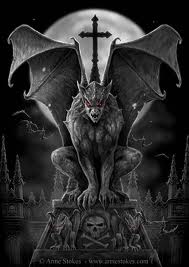
Gargoyles Remastered

The Original
Here is a creature that doesn't stand up to close scrutiny. The problem, I think, is that gargoyles are not based on any monster from mythology or literature but a piece of decorative architecture. This seems to be the reason that gargoyles are often depicted as creatures made of stone, or at least with stone-like skin; they're inspired by statues.

Why would gargoyles have stoney skin at all? Wouldn't it make more sense if they were just flesh-and-blood creatures that people, for whatever reason, often made into statues? This is certainly what medieval architects were thinking when they put gargoyles in cathedrals. Their inspiration was the demons of the bible. They only chose stone because it was a logical material from which to carve a statue.

Gargoyles, then, are a weird case of art imitating art, in which the D&D monster is made of stone because it is inspired by a type of statute, yet the statues that inspired the monster also exist in the typical D&D world...leading us to conclude that crazy people are building statues of a monster that naturally looks like statues. Maybe they want to help the gargoyles sneak in to their churches?

Doing a little research, I discovered that D&D gargoyles did not start out as stone. Volume 2 of the Original OD&D books, Monsters and Treasure, has the following to say regarding gargoyles: "As depicted in medieval architecture, the Gargoyle is a reptilian beast with horns, talons, fangs, bat-like wings, and often bipedal." That seems pretty straightforward. Gargoyles are reptilian creatures that look like the familiar statues from medieval architecture. It's probably fair to assume, if your world contains gargoyle statues, that they were patterned after these winged, lizard-monsters.

When we jump ahead to 1st Edition AD&D we find a similar description: "These monsters are ferocious predators of a magical nature. They are typically found amidst ruins or dwelling in underground caverns." Ok, that leaves a bit more room for interpretation. In fact, it doesn't really give a physical description at all. I guess Gygax is relying on the reader's knowledge of what a gargoyle statue looks like to help him imagine the beast. This may be where the "stoney skin" problem takes root, but I note nothing in the gargoyle's stats to imply it's anything other than flesh and scales.

Next, I reference my 2nd Edition Monstrous Manual. Let's see..."Originally, gargoyles were carved roof spouts, representing grotesque human and animal figures...Later, some unknown mage used a powerful enchantment to bring these horrid sculptures to life. The race of gargoyles has flourished, spreading throughout the world." Oh, 2nd Edition, I should have recognized your foul stench when I was brought on board. Not only is THIS the cause of the whole "gargoyles are monsters made of stone" silliness that bled over into 3E, but the book's explanation is the tired old "some crazy wizard did it" cliché. Blech!

The simplest solution would probably be to return to OD&D's approach and just say that gargoyles are winged bipedal reptiles. Come up with a reason why people decorate their churches with statues patterned after the beasts and move on. I don't find that very satisfying, though. Besides, for whatever reason, when the DM says “gargoyles,” most players are going to imagine monsters made out of rock. Rather than try to wage a hopeless battle to change this, it would be easier to accept that concept and try to invent a better explanation for it than a crazy wizard.

The following is designated Open Game Content via the Open Game License, with the exception of portions defined as Product Identity.


GARGOYLE
"You have coveted material things above the gifts of the divine, and so I give you over to the earth forever. You shall live as beasts and insects, keeping to the dark places of the world for all your days. As you have embraced the coldness of stone above the light and warmth of heaven, stone you shall be forevermore." - The Prophecta

Gargoyles were once divine creatures called the oenar; angelic warriors whose job was to guard sacred places against demons and devils. In their natural form, oenar were humanoid beings of translucent energy with wings made of silvery light. When they appeared on the material plane, the oenar took on physical bodies made of protective stone and hard-packed earth. The oenar often gave these physical forms a monstrous appearance, imitating their demonic adversaries in order to intimidate and confuse them.

Over time, the oenar became corrupted with greed. As they spent more and more of their time in physical form they began to covet jewels and precious metals. The devil Mammon took advantage of the oenar’s growing avarice. He bribed them with gems and gold while whispering of vast wealth hidden in the earth. The oenar became obsessed with finding treasure. One by one, they abandoned their posts as guardians of sacred ground and declared themselves the masters of the earth.

In response, the gods turned their favor away from the oenar and cursed them to a mortal existence. Defeated and permanently trapped in their stoney bodies, the oenar fled into the shadows, trying to hide from the gods they had betrayed. Their degenerate offspring became the creatures now known as gargoyles.

LIVING STATUES
Gargoyles, while not immortal, can live for centuries. They are carnivores, preferring the meat of sentient creatures, but their magical nature allows them to go months without food. Strangely, perhaps due to their close ties to the element of earth, gargoyles never thirst and have no need to drink. They are covetous creatures who like to horde precious metals and uncut gems, which they usually hide somewhere high off the ground. A gargoyle collects treasure only to satisfy its greed; the creatures have no true use for money. A gargoyle will have double the usual chance of possessing each type of treasure, excluding magic items.

Many churches, especially large and ornate cathedrals, still build statues carved in the likeness of gargoyles. This practice dates back to ancient times, when early men made grotesque statues as an homage to the oenar. It is thought that the images of these lost guardians can still ward off demons and evil spirits, and there might be some truth to that belief.

Gargoyles sometimes take advantage of this tradition, hiding motionless amongst statues in order to ambush their victims, particularly in ruined or abandoned places where they are less likely to be noticed. A gargoyle can remain almost completely motionless for a very long time, only revealing its true nature when opportunity or great hunger forces it to move.

Like some types of demons and most undead, gargoyles have an aversion to holy water. While holy water does no damage, even a splash of it will cause a gargoyle to recoil in disgust, thus spoiling its ability to pose as a statue. Also, because of their rock-like skin, gargoyles are susceptible to spells that affect stone.

GARGOYLE VARIANTS
The oenar were not originally stone, but divine entities that took on an earthen form for protection. While the monsters have devolved quite a bit through the generations, their physical bodies remain somewhat mutable. Over a few years, a gargoyle will come to resemble its surroundings, changing in color and even appearance. It is thus possible to encounter a gargoyle in an unexpected form: a winged lion or other mundane animal, for example, if there are statues of that type in the gargoyle's chosen lair. This process is not something a gargoyle can affect intentionally; it is a product of the creature's curse.

KAPOACINTH
Living testament to the gargoyles' adaptability, the kapoacinth are an aquatic offshoot of the gargoyle species. Their bodies are comprised of hard, pale gray or green coral and often covered in algae. Kapoacinth swim at the same speed that a gargoyle flies, using their wings to aid them. Since their wings have adapted to be more like fins, kapoacinth cannot fly. Some scholars believe that kapoacinth originated in the lost nation of Thenos and became aquatic after that country sank into the ocean.